Establishing the Establishment of the Run
If there's one thing you can say about Houston's 2026 draft class – and their offseason as a whole if you look at how they approached free agency on offense – it's that they believe they need to control the ball better through establishing their own run game.

If there's one thing you can say about Houston's 2026 draft class – and their offseason as a whole if you look at how they approached free agency on offense – it's that they believe they need to control the ball better through establishing their own run game.
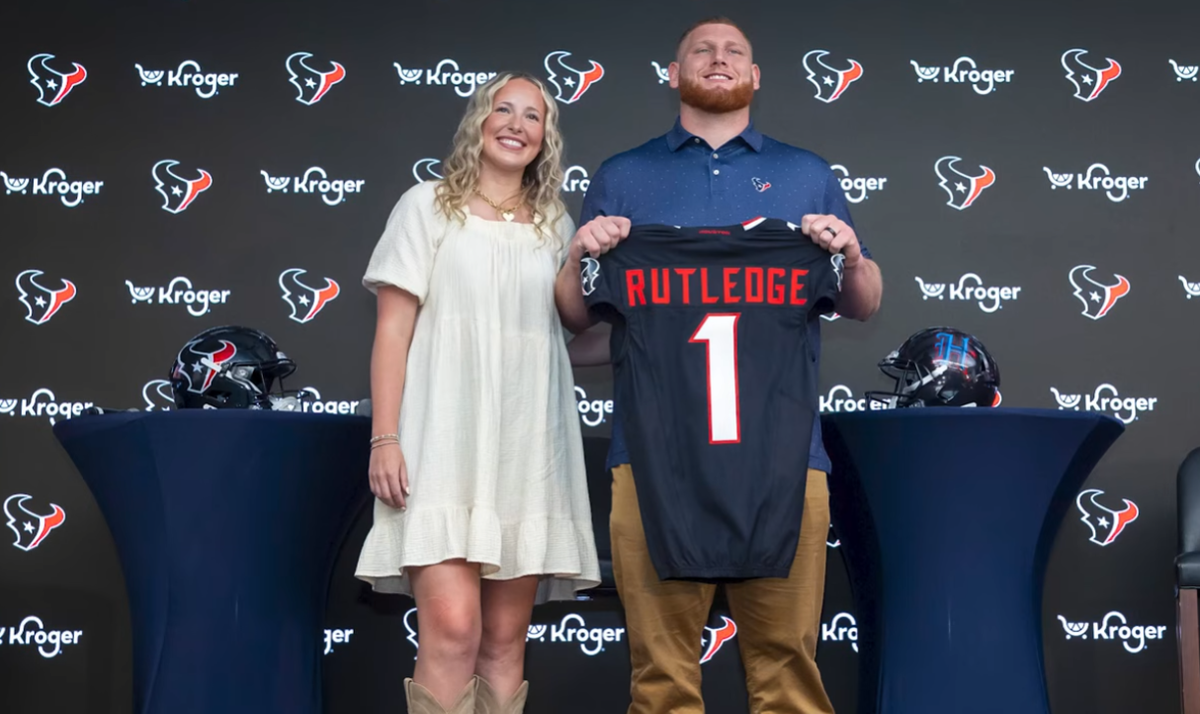
I have nothing but good things to say about Houston's first two picks of the draft. Keylan Rutledge made plenty of sense to me as a stab in the interior line – hopefully pushing Jake Andrews for the starting center gig – and Kayden McDonald is the young interior presence this team didn't have on the defensive line. Do we know that they'll work out? We don't. But they're good football prospects and all the smoke and whispers I hear in the background is that Nick Caserio's department made reasonable trade ups to get them both ahead of positions where they would have been taken.
Draft value is a really interesting concept to consider these days from an outsider perspective. We're in the days where we have a consensus big board and many, many people spend a lot of time talking about and analyzing the draft. When I started seriously working in this arena in the early 2010s, you'd get some first-round mock drafts and maybe a top-100. The complex has expanded greatly. And I think that comes out in a way where it can create a massive amount of groupthink. (And that groupthink can go both ways, actually, as I'll demonstrate in a moment.)
I feel good about the Rutledge pick both because I think it thematically fits what I think this team wants to become and because I think after the first nine or ten picks in this draft, most of the players were vaguely "first-second" round prospects rather than true top-10 guys or surefire first-round picks. If you ever comb the major draft publications (like The Beast) looking for future Texans, you have to make note of football character. They simply value it extraordinarily highly, and it has guided many draft decisions. Rutledge and McDonald were on my radar for the Texans because ... they are those kind of guys. And to a certain point, to get back to draft value, that's fine with me. Even if you don't believe Rutledge was going to go before the Texans picked at 28, he was a second-round prospect on most boards. It's not like they're drafting a schlub. McDonald is an absolute home run pick. Those two picks matter more than any of the ones after them.
The Trade-Ups of Nick Caserio
I developed an early reputation as a Nick Caserio hater and I came by it honestly. The interesting thing about it is: Now that the team is actually good, I think his philosophies make much more sense. To me, if your team is going to be bad – and we can acknowledge it's going to be bad, right Nick?
Thanks.
So if your team is going to be bad, that's when you want a surplus of draft picks. It's when a bigger part of your roster needs to be lottery tickets that could come due for you. It's when you want a huge UDFA class. The Texans instead did this:
Now that the Texans are good? Now I think the Caserio ethos of pounding special teams and making sure you have credible depth layers makes a lot of sense. Why am I drafting a guy in the fourth round hoping he'll be a decent edge rusher when Derek Barnett is still a free agent and I can still bring him back? And if that's the case, why am I so attached to my pick? Shouldn't it be tradeable?
So, yeah, I don't deeply care about trading up for this team as long as the cost isn't exorbitant. I apologize for my heresy to the Analytics Council.
OK, I have set up a good base of positivity. Now let's talk about the next pick.
What to do with Marlin Klein
What I've gathered is that Klein was valued somewhere between the second and fifth round depending on the team. But he was a massive outlier as a second-round pick. He was the 158th pick on the consensus big board, the eleventh-ranked tight end.
NFL teams have their own version of groupthink though, and it works like this: Someone is going to take this player if I don't. They have a good sense of who will be available and who won't. I think the Texans may be right that Klein would have been gone before they picked in the fourth round. It sounded like they had trades in place to move the pick that fell apart at the last minute and they felt like they had to pick somebody.
What it reminded me most of, actually, was when the Texans picked Juice Scruggs in the second round of the 2023 draft. He was the 175th ranked prospect on Arif Hasan's consensus big board. This is a situation where the Texans saw a prospect that checked their boxes – versatility and character – and they had a clear need. I think this is the same trap that the Texans fell into with this pick.
Where that falls apart under further investigation is the relative depth of the classes. Once Scruggs was picked, the next usable center in the draft was – hilariously – Jake Andrews. Luke Wypler led the consensus board, and Olusegun Oluwatimi was next. Those are stopgap starters at best. Klein went in one of the deepest tight end drafts in a long time. And this is a pure projection pick: he had 38 receptions in four years and a 11.1 percent drop rate. He's more of a dogged blocker than someone who jumped off the college tape in the vein of Oscar Delp – not that I'm in any way convinced any metrics or tape scouting can actually identify players that will be good NFL blockers at tight end anyway. Also he wasn't exactly a strong special teams contributor at Michigan, which is weird for a Texans prospect.
The history of tight ends delivering immediate production is rough. And Klein has a lot of depth chart to climb: Dalton Schultz, Foster Moreau, Cade Stover, the return of Brevin Jordan from injury ... I can see why the Texans wanted to upgrade this room, but are they carrying five tight ends? Is someone getting cut or surprise traded? Or are they getting beat out for a roster spot by someone this young with this little passing game experience? Colston Loveland obviously took a major leap from his college production at the same school, but – forgive me Marlin – Klein is no Loveland.
Weird, weird pick. Obviously I don't love it despite hoping it works out. I left this one thinking: Why not a third trade up? I was hoping for a linebacker, myself. The Texans wound up double-tapping that position later, but I think I'd feel a lot better with Jacob Rodriguez or C.J. Allen as a hedge for Azeez Al-Shaair.